Professional but fun
Why "professional but fun" brands need different rules (and how to get it right)
You've seen them. Those brands that somehow manage to look credible and approachable at the same time.
They're not buttoned-up corporate. But they're definitely not amateur hour either.
They sit in that sweet spot where "I trust you with my money" meets "I'd actually enjoy working with you."
And if you've ever tried to create that vibe yourself, you'll know it's trickier than it looks.
Go too corporate, and you feel stiff. Too playful, and suddenly you look like you don't know what you're doing.
So what's the secret?
It's not about finding the perfect magical font. It's about understanding what "professional but approachable" actually means in design terms - and then making intentional choices that support that feeling.
The problem with mixing "serious" and "fun"
Here's where most people get stuck.
They think they need a "serious" font for credibility and a "fun" font for personality. So they mash them together and hope for the best.
What usually happens? Visual chaos.
Because here's the thing: when you're trying to communicate "I'm competent AND friendly," you don't want your design fighting itself. You want harmony with just enough contrast to keep things interesting.
That's where single-font families come in.
Why one font family can do all the heavy lifting
Stay with me - I know it sounds counterintuitive.
But fonts like Poppins (or Montserrat, or Inter, or Work Sans) are designed with multiple weights specifically so you can create variety and hierarchy without needing multiple typefaces.
Think of it like this:
Poppins Bold = Your confident, attention-grabbing voice
Poppins SemiBold = Your structured, "let me explain this" voice
Poppins Regular = Your conversational, "let's chat" voice
Same family. Same design DNA. But different energy levels.
The result? Everything feels cohesive (professional) but not monotonous (still interesting).
What this actually looks like in practice
Let's say you're creating a services page.
Main headline: Poppins Bold, large - "Here's how I can help"
Section headers: Poppins SemiBold, medium - "Strategy," "Design," "Support"
Body copy: Poppins Regular, comfortable reading size - your actual explanations
See what's happening? You've got clear hierarchy (so people know what's important). But it all feels like it belongs together.
No awkward font clashes. No "did they just give up halfway through?" vibes.
But what about colour? (Because fonts don't work alone)
Right. This is where a lot of "professional but fun" brands accidentally tip into "trying too hard" territory.
You need colours that balance energy with credibility. Too muted, and you disappear. Too bright, and you look like a children's party entertainer.
The formula that actually works:
One trustworthy anchor (usually a blue or navy)
One energetic accent (your yellow, coral, or warm tone)
One bold moment (your "click here" colour)
Your neutrals (off-white and a warm dark for text)
Example palette breakdown:
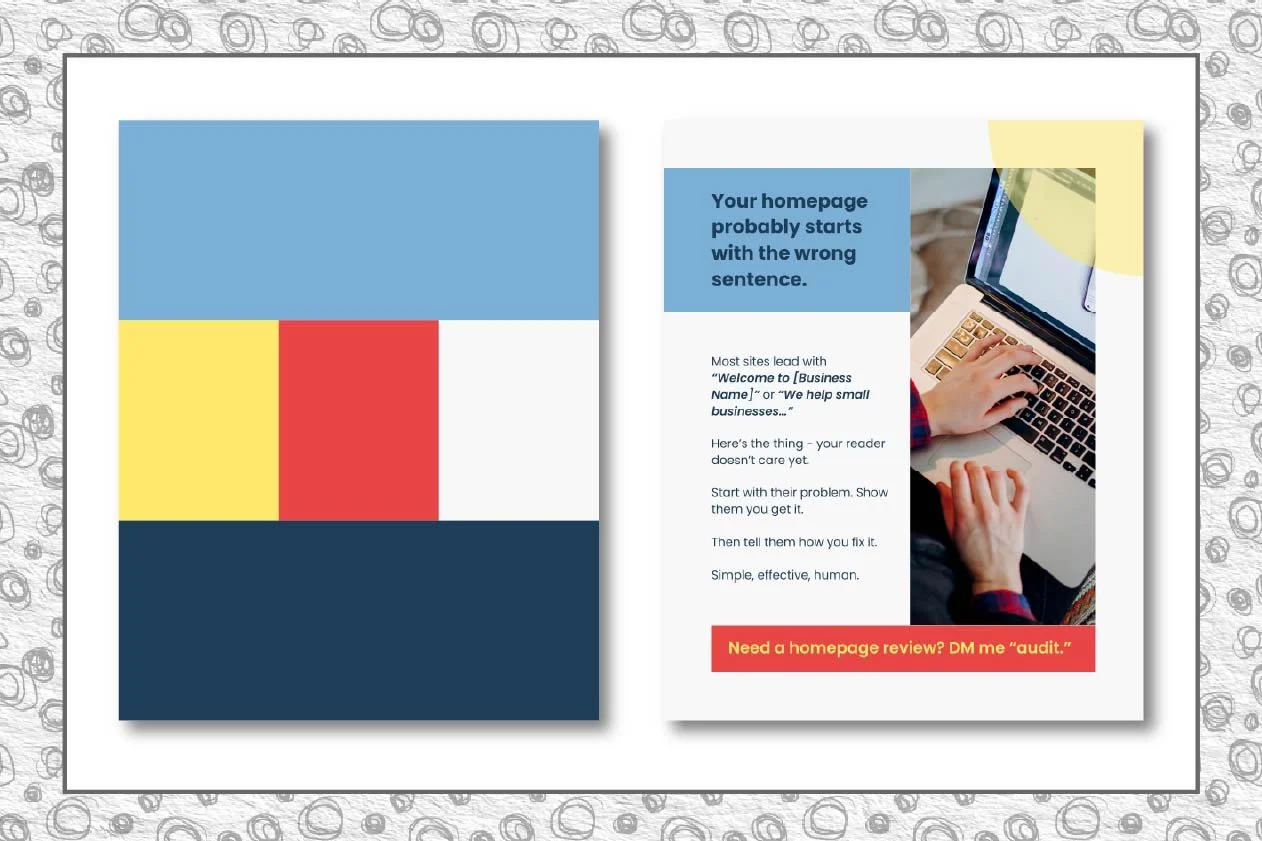
Sky Blue (#7BAFD4) – Your main brand colour. Trustworthy, but warmer than corporate blue. Use this for headers, key sections, brand moments.
Sunshine Yellow (#FFE86B) – Your optimism colour. Use it for highlights, secondary buttons, cheerful accents. NOT for large blocks or you'll give people a headache.
Coral Red (#E84646) – Your "pay attention" colour. Main CTAs, important alerts, the moments that matter. Sparingly, or it loses impact.
Soft White (#F8F8F8) – Your breathing room. Main backgrounds, spaces where eyes need to rest. Softer than stark white, which feels harsh.
Deep Navy (#1E3D59) – Your text colour. Professional but not boring. Easier to read than black, warmer than grey.
The mistake most people make
They use all their colours everywhere.
Every section gets a different background. Every button is a different colour. It's like visual whack-a-mole.
Instead, think in proportions:
60% soft white (your calm, professional base)
25% sky blue (your brand personality showing up)
10% yellow (your energy moments)
5% coral (your "take action" highlights)
This creates rhythm. Your eye knows where to rest and where to focus.
The "modern but trustworthy" balance
Here's what makes this combination work for brands that need to be both:
Clean, geometric fonts equals modern
Poppins has those rounded, geometric shapes that feel current. It's not trying to look like a serious newspaper (that's what serifs do). It's saying "I'm here, I'm now, I understand how things work today."
Consistent visual system equals trustworthy
When everything follows the same rules (same font family, clear colour hierarchy), it signals that you've got your act together. There's a system. There's thought behind it.
That subconsciously reads as "this person probably has their business systems sorted too."
Warm colours and readable type equals approachable
Deep navy text instead of harsh black. Sky blue instead of corporate navy. Sunshine yellow for moments of optimism.
These aren't cold, distant choices. They're inviting. But they're not screaming for attention either.
How to know if this style fits YOUR brand
This clean, friendly, modern approach works brilliantly if you're:
A coach or consultant who isn't stuffy
A creative agency that takes deadlines seriously
A service provider who wants to feel current, not corporate
A lifestyle brand that values professionalism
Anyone building something modern who needs to be taken seriously
It doesn't work as well if:
You're intentionally going for luxury or high-end exclusivity (you'd want more sophistication)
Your audience expects traditional authority (think law, finance - they often need more conventional signals)
Your brand is genuinely playful and irreverent (you'd want more personality in your type choices)
The implementation checklist
If you're thinking "right, I'm doing this" – here's your starting point:
For your fonts:
Pick your weights (Bold for headers, SemiBold for subheaders, Regular for body)
Set your sizes and stick to them (consistency = professional)
Check line height - Poppins needs a bit of breathing room (1.5-1.6 for body text)
For your colours:
Start with your biggest blocks (backgrounds, main sections)
Add your primary brand colour (sky blue) for structure
Drop in your energy colour (yellow) for highlights only
Use your bold colour (coral) for CTAs and nowhere else
Use deep navy for all text (consistency matters)
For bringing it together:
Create one piece (a social post, a landing page section, whatever)
Step back and ask: "Does this feel confident AND friendly?"
If it feels too corporate, add a touch more yellow or round out your shapes
If it feels too playful, pull back on the bright accents and let the structure do the work
It's not actually about finding the perfect font or the perfect colour.
It's about making intentional choices and then being consistent with them.
That consistency? That's what reads as professional.
The specific choices you make - geometric fonts, warm colours, clean layouts? That's what reads as approachable.
Put them together with a bit of thought, and you've got a brand that says "I know what I'm doing, and you're going to enjoy working with me."
Which, let's be honest, is exactly what most of us are actually trying to say.
Not sure if this style fits your brand?
Check out the resources page for this combination and other options. Instant downloadable PDF with colour and font combinations and a free Canva template to get you started.